Your AI agent just ran 47 tool calls in a session. You want to know: did the audit trail capture all of them? Or did someone quietly delete the embarrassing ones?
This question — completeness — is the one that separates real accountability from security theater. And most AI agent audit tools get it wrong, because they chose the wrong cryptographic primitive.
The Landscape
In 2026 Q1, at least ten projects launched with the pitch “cryptographic receipts for AI agents.” They fall into three camps:
| Approach | Examples | What They Prove |
|---|---|---|
| Signed receipts | Circe, AgentMint, Sanna | “This action happened” |
| Hash chains | Unworldly, AIR Blackbox | “This sequence wasn’t altered” |
| Transparency logs | Certificate Transparency, PunkGo | “The log only grew — nothing was removed” |
Each sounds similar. They’re fundamentally different.

Signed Receipts: Proving the Individual
A signed receipt is a single artifact — Ed25519 signature over a JSON payload. You can hand it to anyone, and they can verify:
- This action was recorded
- The signature is valid
- The payload hasn’t been altered
{
  "action": "bash:rm -rf /tmp/data",
  "timestamp": "2026-03-12T14:02:31Z",
  "signature": "base64(Ed25519(...))"
}
The gap: Signed receipts are independent. Delete one, and the remaining receipts still verify. There’s no structural relationship between receipts. If your agent ran 47 actions and you only see 45 receipts — how would you know two were deleted?
You wouldn’t.
Hash Chains: Proving the Sequence
A hash chain links events sequentially. Each event includes the hash of the previous one:
event[0].hash = SHA256(event[0].data)
event[1].hash = SHA256(event[1].data + event[0].hash)
event[2].hash = SHA256(event[2].data + event[1].hash)
If someone alters event[1], event[2]’s hash breaks. Tampering in the middle is detectable.
The gap: Hash chains are verified by walking the entire chain. A third-party auditor needs every event to verify any event. With 10,000 events, that’s 10,000 hashes to recompute.
Worse: truncation is invisible. If the chain has 47 events and someone deletes the last 5, you see a valid 42-event chain. Nothing looks wrong — unless you already knew the chain should be longer.
And if the chain is verified by the same party that writes it — who watches the watchman?
Transparency Logs: Proving Completeness
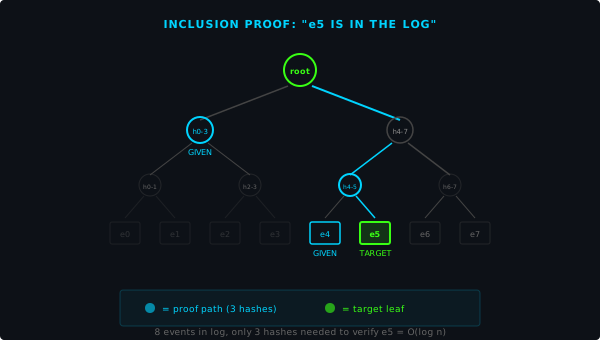
A transparency log (RFC 6962) stores events in a Merkle tree — a binary tree of hashes where the root summarizes the entire log. This structure gives you two things hash chains cannot:
Inclusion Proof
“Event e5 is in the log.” The proof is a logarithmic number of hashes — for a log with 1 million events, you need ~20 hashes, not 1 million. Any third party can verify it without seeing any other event in the log.
Consistency Proof
“The log grew from size 4 to size 6, and the first 4 events are unchanged.” This is the key primitive.
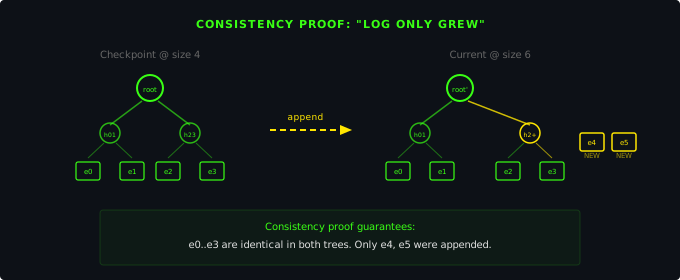 If you checkpoint the tree at size 42, and later the tree is at size 47, the consistency proof mathematically guarantees that:
 - No events were deleted
- No events were reordered
- The only change was appending 5 new events
This is what “completeness” means. Not “this event exists” (signed receipt). Not “this sequence is intact” (hash chain). But “the log only grows, and I can prove it to anyone.”
This Isn’t Theoretical
Certificate Transparency has been running this exact architecture at global scale since 2013. Every TLS certificate issued by a public CA is logged in a transparency log. Browsers enforce it. The result: rogue certificates are now detectable within hours, not years.
Go’s module ecosystem (sum.golang.org) uses the same structure. Every Go module version has a transparency log entry, and go mod verify checks inclusion proofs locally.
Sigstore’s Rekor does the same for software signatures.
The math is RFC 6962 (and the newer RFC 9162). The checkpoint format is C2SP tlog-checkpoint. These are not proprietary — anyone can implement a verifier.
A Concrete Example
Here’s what a Merkle inclusion proof looks like in practice. The same proof, verified by two independent implementations in different languages:
Rust (using tlog_tiles crate):
let valid = tlog::check_record(
    &proof,        // logarithmic hash path
    tree_size,     // current tree size
    tree_root,     // current root hash
    leaf_index,    // which event
    leaf_hash      // event's hash
);
Go (using golang.org/x/mod/sumdb/tlog):
err := tlog.CheckRecord(
    proof,        // same hash path
    treeSize,     // same tree size
    treeRoot,     // same root hash
    leafIndex,    // same event
    leafHash,     // same hash
)
Same math. Same proof. Two languages. Zero trust required between them.
The Decision Framework
When choosing a cryptographic primitive for AI agent audit trails, ask:
Can a third party verify a single event without seeing the entire log?
- Signed receipts: Yes, but can’t detect deletions
- Hash chains: No — need the full chain
- Merkle trees: Yes — O(log n) proof
Can you detect if events were deleted from the end?
- Signed receipts: No
- Hash chains: No (truncation is invisible)
- Merkle trees: Yes — consistency proof
Is the verification protocol standardized?
- Signed receipts: Various (Ed25519, HMAC, JWS…)
- Hash chains: Usually custom
- Merkle trees: RFC 6962 / 9162, C2SP checkpoint
What This Means for AI Agents
When an AI agent runs for 8 hours overnight, editing your codebase, deploying to production, and managing infrastructure — the audit trail is the only thing between “I trust my agent” and “I can prove what my agent did.”
“I trust” is a policy statement. “I can prove” is a mathematical one.
Hash chains give you tamper detection. Merkle trees give you tamper detection + completeness + efficient third-party verification. The engineering cost is comparable. The accountability gap is not.
The transparency log approach described here is what we built into PunkGo — an open-source Rust CLI that creates RFC 6962 audit trails for AI agent actions. The Merkle proofs are cross-verifiable with Go’s standard sumdb/tlog library.